Reading for threats
A member of Congress wants me to donate because “this bill just passed the House!” Donating, they say, will stave off disaster. But I know it won’t pass the Senate. And this politician knows it too. I feel deceived. It’s one more current in a stream that pulls me under dozens of times every day through texts, email, and social media.
I subscribe to The New York Times and The Wall Street Journal, but increasingly I read international newspapers and a few Substack writers I trust. I fact-check real-life implications with real people – lawyers, doctors, and others who know the truth beneath the talking points. It can feel like a full-time job.
When it comes to this kind of discernment, I consider myself capable. I spent a career in public relations trying to influence the news, so I understand how it works. Anytime someone takes an article as the whole truth, I tell them to look at who’s quoted and consider their motivation. People generally talk to the press to fuel their egos, their profits, or their agendas. And very often, these spokespeople bring stories to reporters, not the other way around. With so much swirling though, it’s nearly impossible to keep it all straight. Anything can be staged.
I spent a good part of the summer immersed in old issues of LIFE magazine. As I scanned a 1959 issue, I saw balloons floating into the air above a joyful crowd. Then I saw that this was a parade in Tiananmen Square celebrating Communism. A few pages later, Richard Nixon was pictured in another at a presidential campaign stop in Concord, NH, near a banner that read, “Dartmouth doesn’t give a dam for anyone but Dick.” Flipping ahead again, in a very different kind of staging, a Dallas theater company performed Shakespeare’s “The Tempest” (as an act of resistance?) which, you may recall, ends when Prospero forgives his enemies and gives up his magic along with his effort to control the world. Sound familiar?
I was supposed to be collaging, but when I opened the December 31, 1971 issue of LIFE, I began reading. It could have been published today, and I let it pull me in. “The Jesus Craze: Kids get religion and the cash registers jingle.” “Homosexuals in revolt.” An unpopular war. And then, a personal essay from writer John Neary called “Looking for ourselves in the news of 1971.” He wrote about how he, his wife, and kids gradually became numb from the bombardment of bad news. When they heard on the radio that a tidal wave in India killed 6,000, and a bombing killed two in Belfast overnight, unfazed, they kept eating their breakfast.
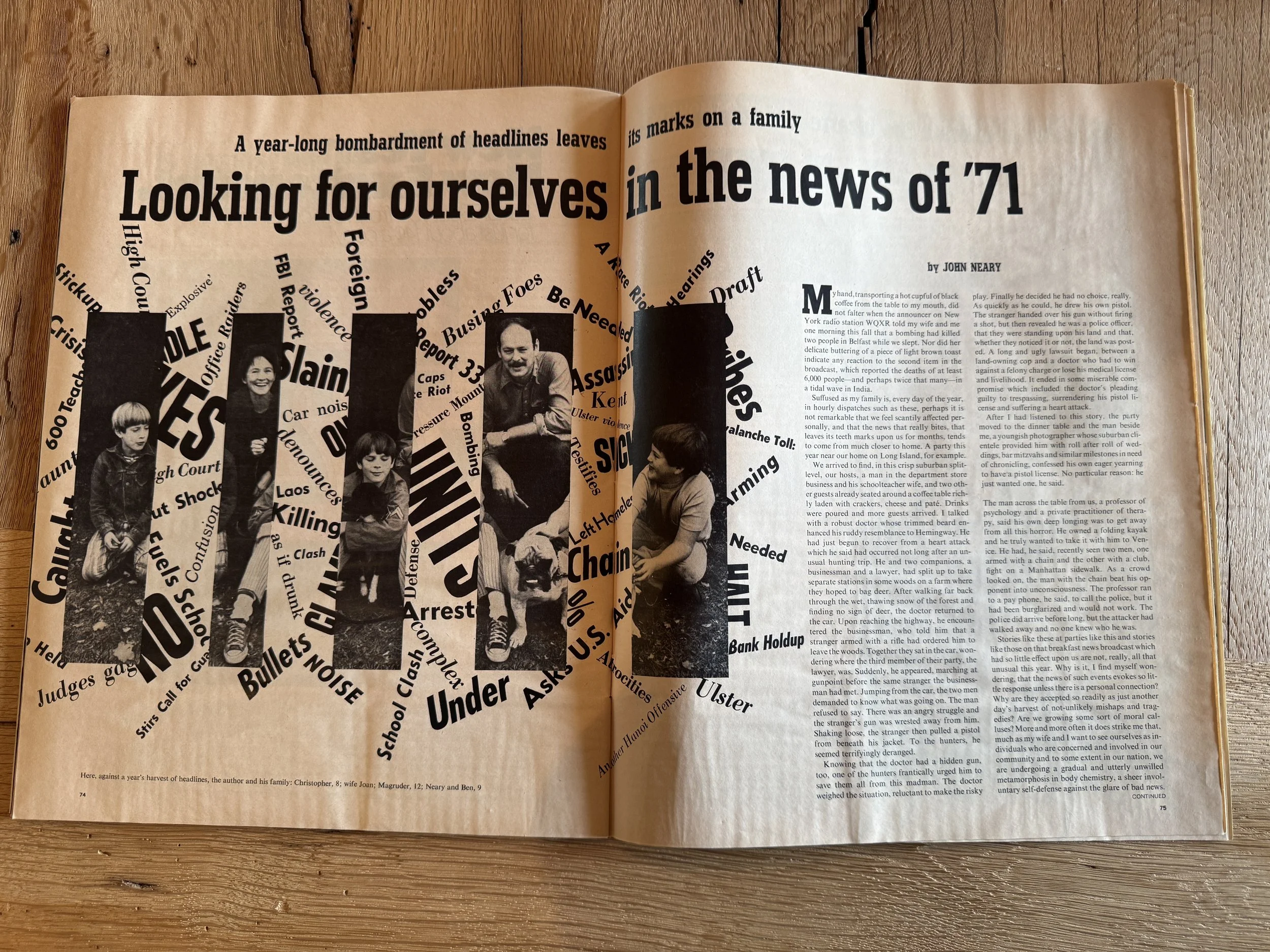
He wrote: “…I am beginning to suspect we are experiencing a thickening of the heart’s membrane against the demand of the news on our reservoirs of empathy, concern, compassion and outrage... And I wonder if…it has not been happening for a long time, a steady accretion of tolerance for the bizarre and intolerable.”
This is called compassion fatigue. We withdraw, as did Neary, who set out with his family away from the radio and the newspapers. “Vacationing did seem to indicate to us the right direction: inward…For us, silly as it may sound, lasting significance lay [with] a laughing black horse who discovered that he shared our children’s love of oranges, and in a family of beavers we met.”
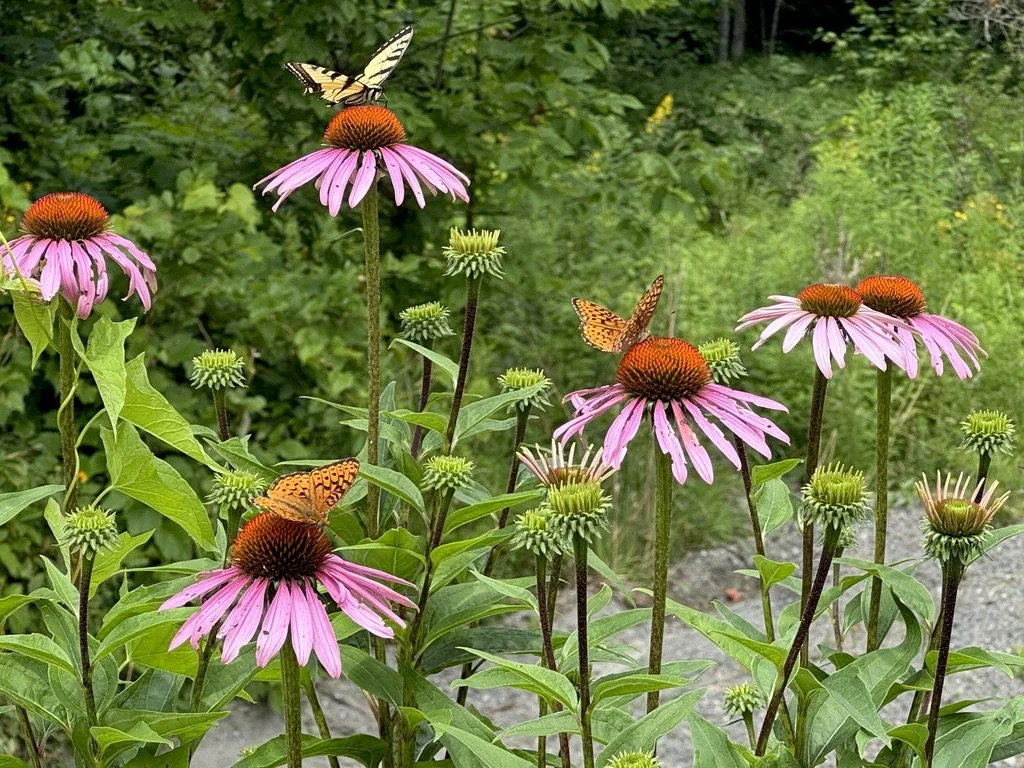
I too retreat to close-felt realities. In Vermont, I watch the goldfinches in their summer yellow, falling for them when I learn that mated pairs develop unique songs to find each other in the flock. Butterflies flutter around the coneflowers, not minding my company. My husband and I trim the lilac tree of its dead branches, thinking of how happy it will be to have more space to open next spring. I spread out my art materials on our long table that looks out into the field, leave my phone in the kitchen, and lose myself in my work.
Vigilance isn’t a design flaw. Sure, you could blame yourself for your news or social media obsession. I used to, until I learned that we’re wired to look for threats. Once the algorithms learned this, they went wild. Because, as Neary wrote long before we had smartphones, “…we come back again and again for more, despite that numb feeling. Rather, it is our undeniable sense that we have been watching and reading about ourselves.” We’re imagining what we’d do in similar circumstances, all just looking for holes in our boats.
We aren’t going to change how the algorithms work. I count on the news, now more than ever. Like everyone, I fall overboard and swim around frantically trying to discern fact from narrative, expert from pundit, journalist from influencer. In this state, I can become obsessive, checking my phone for updates in the middle of the night. I’ve charted a reliable pattern: my interest turns to hypervigilance, and then, exhausted, my compassion begins to drain.
When it comes to our attention, noticing its direction is the moment we have agency. Over the past year, I’ve taken myself offline for long stretches to settle my nervous system. I find my way back to the butterflies and the goldfinches. Because I need to re-engage with the world, and my own little world needs me to see it with clarity. Reality asks a lot of us. Neary’s son about Vietnam: “All I can think of is that guy in his rice field that wants the war to stop.” My daughter wonders if she’ll be able to grow old, if the earth will be hospitable when she is 50. I want to be the one to teach her how to engage and fight for the things she loves.